
Our Acupuncture Tinnitus Study Data is in!
Better Body Health
2026-10-19
We are very excited to announce that our data is finally in and that it looked really good. Originally, we set out with one simple goal in mind: Can tinnitus-related difficulties improve with acupuncture (SAAT Acupuncture) —and do changes last after the needles are removed? We tracked 15 participants’ Tinnitus Handicap Inventory (THI) scores at intake, at week 3 when the SAAT needles were removed, and again at week 12.
What does the THI measure?The THI measures how much tinnitus affects a person’s daily life. Lower scores are better: they indicate less tinnitus-related handicap. Our patients averaged 34.4 out of a possible 100 maximum score.
How did we treat patients?Fifteen patients were treated using one small micro needle in the right ear using Soliman Auriculotherapy Acupuncture Method (SAAT) and the needle was left in place for a period of three weeks. At the three week mark the needle was removed and patient progress was tracked through week 12.
What did we see?Our outcomes looked really good. Across participants with scores available at each timepoint, the average THI score fell from 34.4 at intake to 26.1 at week 3. At week 12, the average was 28.6—still lower than at intake, although it had risen somewhat from the week-3 average. Was is even more remarkable is that our results were actually the same at week 12 as week three if we did not consider one single patient's numbers 12 week result that had increased(he had a bad case of flu on the day we completed the study). We did however include his numbers for simplicity's sake, as much as that killed me.
Overall, 9 of the 13 patients that completed the study showed improvement at the 12 week mark. (Four of those saw at least a 50% reduction in their score). Two patients noted no change while two patients notes a slightly higher number (our flu case being one of them). Average THI scores using the original participant dataset. Intake: n=14; week 3: n=14; week 12: n=13. Lower is better.
Why the follow-up mattersThe week-12 check gives us a look at scores nine weeks after the needles were removed. The group average remained below intake, while also showing a small increase between week 3 and week 12. Individual experiences varied, which is why looking at both the group pattern and each person’s results is useful. Thank you to everyone who took part and shared their scores. Each follow-up helps us better understand the condition and what works for it. Please Note: This post discusses the study we did on patients with Tinnitus and what we observed. This post does not guarantee outcomes for individuals with the same condition.
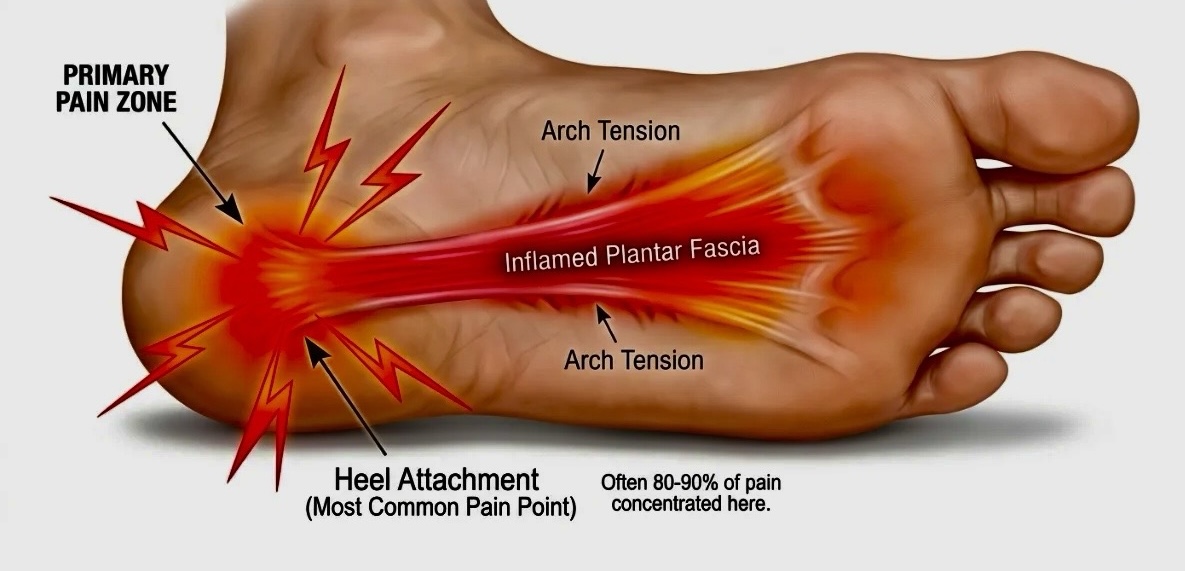
Plantar Fasciitis: What If Your Flat Feet Aren't Really the Problem?
Better Body Health
2026-10-05
If you've ever been told that your plantar fasciitis is caused by "flat feet" or "a dropped arch" or overpronation, you are not alone. I myself used to believe this and tried many different arch lifts and shoe inserts in the hunt for the perfect solution. Here is what I learned in my quest for a more permanent solution to a problem that bugged be the greater part of my teens and twenties:
For years, the story that I was given is that my arch collapsed (they were vague on the how), that my foot was rolling inwards putting undue stress on the ligament solely responsible for keeping this hot mess together. I was given inserts and a printout explaining that the ligament was the problem, with various torturous exercises I was expected to complete daily. You know the ones - the tennis ball, stretching in a corner, toes up the wall, the wet towel, the frozen bottle of water. You name it, I did them. It sounds logical.
But there are two problems with this: the foot is more complicated than simply having a high arch or no arch and more importantly, this was not working for me. None of the inserts, podiatrists, shoe recommendations were more helpful than maybe a brief break or slight improvement in the pain. I was limited in what I could wear and what I could do. I gave up on sport I loved with little to no effect.
The Flat Foot Theory Debunked
Traditionally, were taught that a lowered medial arch and excessive pronation puts additional stress on the plantar fascia. New research now associates altered rearfoot biomechanics (or movement) that actually causes the stress on the ligament. Another way of putting it is that the fascia is the smoke, not the fire as they say. Rather, it is the lack of movement of the ankle joint and the heel that causes the problem in the first place. It frustrates me how many foot doctors here in Northwest Arkansas (and shops hogging expensive insert systems) still abuse this outdated belief. It is a little like putting a Band-Aid on a cut and saying the Band-Aid will fix the cut and prevent future cuts. It makes no sense. I remember always thinking that we were made for walking barefoot on this flat earth and walking barefoot should not be as bad as they say it is. If God wanted us to have inserts or Nike surely it would have been in the womb. It just did not sit well with me.
What We Do Instead
Simply put, we fix their patients. We see a lot of Plantar Fasciitis patients traveling from as far as Missouri, Bentonville and Little Rock that have the special inserts but still have trouble. A lot of them have been in pain for several years. Rather than treating the Fascia, we treat the foot.
Our first step is to evaluate your foot and see if any of the mechanisms in the rear foot or front foot are "stuck". Our first treatment is relatively painless and is done in less than 15 minutes. We use simple, no/low force corrections to address the underlying cause of the problem. We reevaluate the area we treated for two more weekly visits. If any lingering pain remains at the three-week mark in the case of those with more longstanding problems, we apply shock wave therapy (Piezo Wave by Wolf Medical) to the area to promote further healing.
What We Do Not Do
We do not make you feel like your body is broken and needs intervention to function. We do not send you home with 10 pages of exercises. We simply teach you what not to do. We do NOT use foot inserts (you can probably tell I hate them, right?). I believe that they are a huge waste of money in most cases and a short-term patch in other cases. We do not keep you coming back in past resolution of problem under the guise of "maintenance" or "you need to see us, or this will come back". We fix you, teach you what not to do and tell you to bring it back if it malfunctions again. Most of our patients don't need to. Moreover, we do not push any brand of shoe. There is no one-shoe-fits-all here.
How Long is Treatment?
Each session lasts about 15 minutes, and the sessions are done weekly. We see improvement of symptoms in most of our patients in about a month or so. Resolution of symptoms can vary based on your case complexity and the amount of damage to the surrounding tissue (things like bone spurs etc). I like to joke that I do not get to know many foot patients too well. I have a lot of former foot patients send me new foot patients and I do not always recognize the names well.
What Causes Plantar Fasciitis? How Do You Avoid It?
The biggest part of a successful treatment plan for this specific problem is education of what caused the problem in the first place. Honestly, it is the main thing. What I see clinically is rather than pronation, the foot is supinated excessively through bad sitting habits at home. A simplified way of saying it is that you tend to sit with the heel turned in, putting pressure on the outside edge of the heel or foot in general. This usually happens when a patient crosses their ankles wrong habitually or uses that foot incorrectly on the gas pedal while driving. The correct position is pressure on the back/ bottom of the heel. If you find that you roll your knee to the outside while driving and put pressure on the outside edge of the heel, you are working on plantar fasciitis. Maybe one of these days I will actually publish that video showing these bad habits, but like most I simply hate hearing my own recorded voice and keep putting it off.
We also educate things like the correct use of a ladder (never barefoot, in flip-flops or straddling the rungs like a bird on a wire). We talk about the correct structure of shoes that will work with your foot.
The system I use to treat your feet is one that was taught to me by the same person that fixed my feet. It has been 17 years since my last episode of pain and I wear whatever shoes I like, no inserts. I am barefoot when home for the most part. I have managed to work all the way through 2 pregnancies with no side effects, despite being on my feet 12 hours most days on hard concrete floors. I do so simply by understanding what PF is, what causes it and avoiding the foot postures that promote it. It is a subject that runs near and dear to me, because I understand the pain so well.

Treatment for Alpha-gal Allergy
Better Body Health
01/26/2026
At Better Body Health, we specialize in electroacupuncture for the treatment of alpha-gal allergy. We serve patient from Fayetteville, Springdale, Rogers, Bentonville and the surrounding areas (as far away as Oklahoma, Missouri, Tennessee, Mississippi, Louisiana and Texas). This technique provides unparallelled results for the treatment of alpha-gal allergy.
Most patient require only one in-office treatment with no continuous wear needles required that some other techniques require. If it is determined at the recheck that a second treatment is required, re-needling is done free of charge.
Better Body Health does not provide treatment for those who have experienced anaphylactic shock to alpha-gal containing items. Although we provide treatment for those who have experienced severe reactions (hives, rashes, itching, diarrhea, nausea, vomiting), we do not provide treatment for those who have experienced any of the following: loss of consciousness, low blood pressure or difficulty breathing.
Electro-needling sessions last about one hour and is intended to stop reactions to alpha-gal containing items. A blood tests for alpha-gal sensitivity is available in office if you are not sure if you are sensitive but is not required prior to treatment. If you have shown elevated titers before, your results may or may not change after needling. Patients are provided an alpha-gal exposure plan after treatment to confirm they are no longer experiencing allergic reactions.
About Alpha-gal Allergy
Alpha-gal is known as "red meat allergy" or "mammalian meat allergy". It is an allergy to a sugar found in most mammals called galactose-alpha-1,3-galactose (alpha-gal for short). Alpha-gal is not only found in the meat of mammals but can also be found in the products derived from mammals. These include some cosmetics, medications, personal hygiene products, vaccines and more. Due to the large number of items containing alpha-gal, it can be very difficult to avoid.
Alpha-gal has been linked to the bites of lone star ticks. Research has now confirmed that other insects like chiggers can also spread the allergy. Not everyone develops an allergy to alpha-gal after a bite, as there is a multitude of factors involved for the allergy to occur. These include genetics, overall immune status and other environmental factors.
Pricing
The base price is $180, depending on what testing shows at the initial visit. Pre-treatment is required if testing indicates that a patient is allergic to metal used in the ear.
If testing shows that the first treatment was only partially successful, re-needling is done free of charge.
Who Qualifies for Treatment?
We do not accept patients with a history of anaphylactic reactions to alpha-gal items. Electro-needling requires the patient to remain still for a sustained period to ensure safety and effectiveness. For this reason, very young patients or individuals who are unable to lie comfortably and remain still may not be appropriate candidates for electro-needling.
These statements have not been evaluated by the Food and Drug Administration. Any services or products are not intended to diagnose, treat, cure, or prevent any disease.

Soliman Auricular Allergy Treatment
Better Body Health
2026-02-13
SAAT is a minimally-invasive, drug free approach to confirming and treating allergies. Compared to other common treatments, this specialized and simple acupuncture treatment can reduce allergy symptoms by 80-95% and provide longer relief from allergy symptoms, just by placing one needle in the ear.
Dr. Nader Soliman, M.D., board certified in anesthesiology and medical acupuncture, developed the SAAT protocol and notes that in 20 years of practicing this method, most cases remain stable for several years, some for decades. Some hormonal shifts such as pregnancy or menopause may cause the need for re-treatment.
Dr. Hannelie is one of the few providers in Northwest Arkansas that is trained and certified by Dr. Soliman to administer SAAT treatment.
What does SAAT treat?
* Seasonal and Environmental Allergies
* Food Allergies
* Mast Cell Activation Syndrome - MCAS
* Alpha-gal intolerance
How Many Treatments will I need?
If the needle stays in place for three weeks, most people only need on treatment. There is no additional cost for re-treatment of the same allergen should this be needed, unless you had re-sensitization after a tick bite in the case of Alpha-gal intolerance.
Does it hurt?
The needles used in SAAT are extremely fine (barely visible to the naked eye). Sensation is minimal during placement, and the needle should not hurt after treatment (unless pressure is applied to the ear such as putting earbuds in). The use of over-the-ear headphones or bone conduction earbuds should be fine. We are also able to work around most hearing aids. The needle is covered after treatment with a small plaster, similar to the ones used for blemishes and this hides the needle from view.
Who is not a good candidate for treatment?
SAAT may not be appropriate for people who have severe uncontrolled asthma, people with very severe (bleeding) psoriasis inside the ear (our plasters will not be able to cover the needle effectively), or high-risk pregnancies.
For those of our patients allergic to metals or the adhesives we use may require pre-treatment with homeopathic sprays prior to receiving their needle.
You may also want to book your appointment away from beach/pool vacations as your ear will have to be kept dry post placement for a period of 3 weeks. We will give you ear covers that can be used in the shower, but prolonged exposure to water is not recommended.
What is the cost?
The fee is $350 for your needle(s). This fee includes your examination, allergy test, treatment and follow-up examination/ needle removal visit. Up to three allergens can be treated per session.
If homeopathic sprays are needed for either metal/adhesive sensitivity, or allergens that are resistant to treatment, additional costs may apply.
Is it safe?
SAAT is a minimally invasive treatment with a very long track history. While infection is always possible after skin puncture, every precaution is taken to assure safe outcomes.
Why Choose SAAT?
SAAT offers many benefits:
*Long-Lasting Relief - many patients experience long lasting relief with just one treatment.
* Highly Personalized - We treat your specific allergies based on your body's unique response
*Non-Pharmaceutical - It is ideal for those seeking natural care or looking to reduce medication use.
*Minimally Invasive - Just one small needle stays gently taped in place for three weeks.
Note - SAAT should complement, not replace, the care you receive from your primary care provider.